For decades, the safest marketing advice for a chartered accountant was “don’t”. The rules on advertising were strict, rarely explained, and most firms relied on referrals and a basic website. That changed on 1 April 2026, when ICAI’s revised Code of Ethics brought in updated Advertisement and Website Guidelines.
The changes give CA firms more room to be visible, but the core ban on soliciting work is still in the Chartered Accountants Act. This guide to marketing for CA firms sets out what the revised rules allow, what they still prohibit, how each channel is treated, and a practical plan a small or mid-sized practice can follow without risking a disciplinary complaint.
What changed on 1 April 2026
At its 447th meeting on 12 December 2025, the ICAI Council approved amendments to the provisions on advertisements and websites in the revised Code of Ethics. ICAI said the aim was to let CAs present their services in a more contemporary way. The revised Code took effect on 1 April 2026.
Firms can now describe their specialised services in more detail, share educational content on digital platforms, run knowledge-sharing webinars and keep a fuller website. What the update does not do is turn a CA firm into an ordinary business that can advertise however it likes.
The rule that hasn’t changed: no solicitation
Two clauses in Part I of the First Schedule to the Chartered Accountants Act, 1949 still set the boundaries:
- Clause (6) treats it as professional misconduct to solicit clients or work, directly or indirectly, by circular, advertisement, personal communication, interview or any other means.
- Clause (7) prohibits advertising professional attainments or services. Its proviso allows a member to publish a “write-up” of their services and particulars, but only within the Council’s guidelines.
So the 2026 changes widen what a write-up may contain. They don’t remove the ban on chasing work. ICAI’s disciplinary board continues to act on solicitation: in 2026 it reprimanded a member for soliciting an audit and disparaging the successor auditor. Cold-calling CFOs about audits, or paying a commission-based agent to do it, remains a clear breach.
Exclusive and non-exclusive services: the line that decides most questions
Many of the revised rules depend on whether a service is reserved for chartered accountants by law (for example, statutory audit or tax audit) or is a service anyone can offer (for example, bookkeeping, GST advisory, business registrations or virtual CFO work).
| Exclusive (reserved) services | Non-exclusive services | |
|---|---|---|
| Examples | Statutory audit, tax audit, other attestation required by law | Bookkeeping, GST and tax advisory, company registrations, virtual CFO, management consultancy |
| Website, search and directories (“pull”) | Allowed, within write-up rules | Allowed, within write-up rules |
| Emails, newsletters and other “push” promotion | Not allowed | Allowed, within write-up rules |
| Client names in a write-up | Client’s name only, with permission | Name and nature of work, with permission |
| Listing on app-based aggregators | Not allowed | Not barred |
“Pull” means the person comes looking for you: they visit your website, search Google or open a directory. “Push” means you send information to people who didn’t ask for it. Most compliant CA marketing is built on pull.
What a firm’s write-up may include
The write-up is any descriptive content a firm uses to present itself, from a brochure to a website’s About page. Under the revised guidelines, a firm’s write-up may include:
- Firm name with the “Chartered Accountants” suffix, ICAI firm registration number and year of establishment
- Head office and branch addresses, working hours and contact details
- Number of partners and their particulars, and employee numbers by category
- The CA India logo and the firm’s website address
- Services offered, and any network or alliance the firm belongs to
- Client names (and, for non-exclusive services, the nature of work), with the client’s permission
Every write-up must be honest and factual. It must not contain exaggerated claims, references that disparage other firms, monograms or catchy slogans. Awards from the Central or State Government or a regulator may be mentioned; private awards and paid “best CA firm” accreditations may not. Testimonials and endorsements are still not permitted.
Channel by channel: what’s allowed
Your website
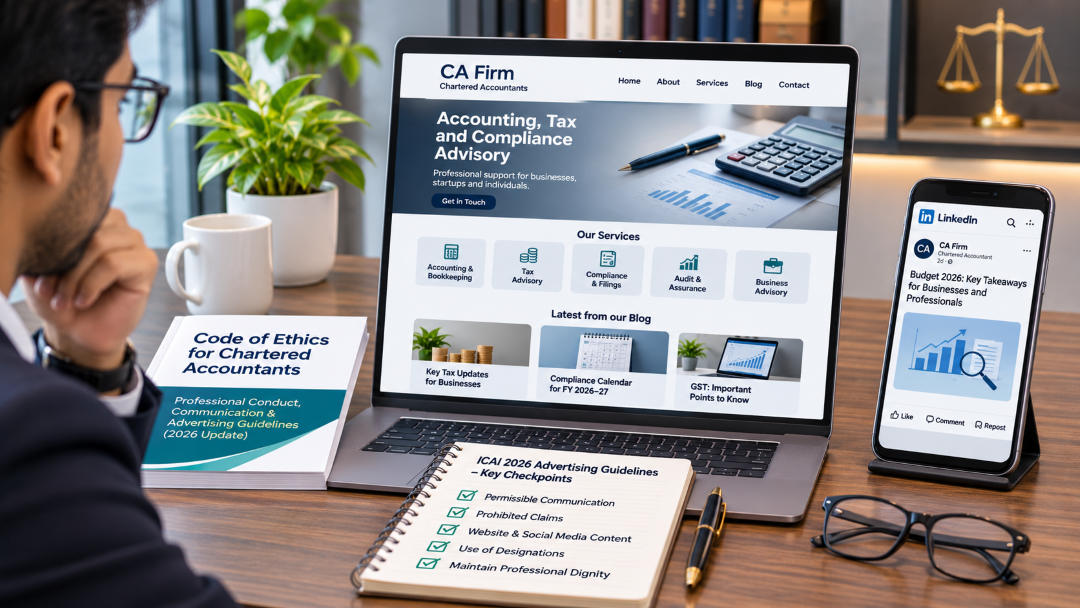
A website is the centre of compliant CA marketing because it works on pull. The guidelines permit firm and partner particulars, blogs, articles and bulletins, educational videos, photographs, a secure client document portal, a link to the firm’s social media page, and links to ICAI, regulatory and government sites. Banner advertisements, content that solicits work, requests to “like” or follow the firm’s pages, and details that differ from ICAI’s records are prohibited.
Google search and Google Business Profile
Being found through a search engine or directory counts as pull, so a listing is permitted for all services, including reserved ones. A Google Business Profile should be treated as a directory listing: accurate firm particulars, services, hours and a link to your website. Avoid slogans or claims like “No. 1 tax consultant in Hyderabad”. Google reviews raise a practical question because they work like testimonials, so don’t request them in bulk, offer anything for them, or quote them on your website. ICAI has not, as far as we could find, issued a specific note on online reviews.
LinkedIn, Instagram and YouTube
A firm may have a social media account, with content that follows the advertisement guidelines. Educational content works best: Budget explainers, GST updates, due-date reminders and short videos on common questions. Members who use “CA” with their name while sharing views publicly should remember that conduct which brings disrepute to the profession can be “other misconduct” under Part IV of the First Schedule, even when it is unrelated to professional work.
Email newsletters and WhatsApp broadcasts
These are push channels. They may be used for non-exclusive services, within write-up rules, and not to promote reserved services such as audits. Send them to clients and people who opted in, never bought lists.
Paid ads, newspapers and aggregators
The summaries of the revised guidelines we reviewed do not specifically address paid search or social media ads. A paid ad shows your content to people who didn’t ask for it, so treat it as push: non-exclusive services only, write-up content only, and check with ICAI’s Ethical Standards Board before spending. Newspaper ads can carry a firm’s name only in limited cases, such as recruiting staff for your own office. Listing reserved services on app-based aggregators is not permitted, and on third-party advice platforms the firm name with the “Chartered Accountants” suffix is not allowed.
Fees and tenders
ICAI has advised members against mentioning fees in advertisements and on websites, including offers of free or reduced-fee services. Separately, ICAI’s tender guidelines of 12 October 2026 say members should not respond to a tender for reserved services that doesn’t set minimum fees, and should not quote extremely low fees.
Risky wording, and safer alternatives
| Risky | Why | Safer |
|---|---|---|
| “Hyderabad’s most trusted CA firm” | Exaggerated, unverifiable claim | “Chartered Accountants, est. 2012, serving businesses in Hyderabad” |
| “Statutory audit at ₹15,000 only” | Fees in an advertisement; push for a reserved service | A blog post explaining when a company needs a statutory audit |
| “Our clients love us: ★★★★★” | Testimonial or endorsement | A list of services and sectors you work with |
| “Follow us for daily tax tips!” on the website | Soliciting likes or follows | A plain link to the firm’s LinkedIn page |
| “Winner, Best Emerging CA Firm 2026” (private award) | Private awards are not allowed | Leave it out; mention only government or regulator awards |
| Cold WhatsApp to local businesses offering audits | Direct solicitation of reserved work | A GST update shared with existing clients who opted in |
A compliant marketing plan for a small CA firm
- Audit your current presence. Check the website, Google Business Profile and social pages against the write-up list above. Remove slogans, star ratings, fee mentions and private awards.
- Match ICAI’s records. Firm name, registration number, partners and addresses should be the same everywhere.
- Rebuild the website around services and sectors. Give each non-exclusive service its own page, written factually, with a contact form for enquiries.
- Publish educational content on a calendar. Tie it to the compliance year: advance tax, GST annual returns, TDS changes, Budget and new-law explainers. Two useful posts a month beat daily filler.
- Use partners’ LinkedIn for thought leadership. Commentary on new rules, short explainers and webinar recordings build recognition without selling.
- Keep the Google Business Profile accurate. Update hours, services and posts about regulatory changes; don’t run review drives.
- Send a newsletter to existing clients. Focus it on updates and deadlines; keep reserved services out of it.
- Keep an approval log. A partner should check every post and page before it goes live, especially when an agency writes it.
Frequently asked questions
Can CA firms advertise in 2026?
Yes, within limits. Since 1 April 2026, the revised Code of Ethics lets firms publish a fuller write-up and share educational content across websites and social media. Soliciting work is still professional misconduct under clause (6) of Part I of the First Schedule, and testimonials, slogans and exaggerated claims are still not allowed.
Can a CA firm run Google or Instagram ads?
The guidelines don’t clearly address paid ads. Because a paid ad reaches people who didn’t ask for it, treat it like push promotion: keep it to non-exclusive services and write-up content, and check with ICAI’s Ethical Standards Board before you spend.
Can a CA firm mention client names on its website?
Yes, with the client’s permission. For reserved services such as statutory audit, only the client’s name may be given. For non-exclusive services, the nature of the work may also be described.
Can a CA show its fees or offer a discount online?
No. ICAI has advised that mentioning fees in advertisements and on websites is not permitted, and free or reduced-fee offers fall within that advisory.
Is it the firm’s responsibility if a marketing agency posts something non-compliant?
Yes. The content is published in the firm’s name, so the firm answers for it. Brief your agency on the guidelines and approve every post before it goes live.
Key takeaways
- Marketing for CA firms became more open on 1 April 2026, but the ban on soliciting work under clauses (6) and (7) still applies.
- Whether a service is reserved for CAs decides most questions, from newsletters to client names to aggregator listings.
- Build on pull channels: a factual website, search and directory listings, and educational content.
- Avoid testimonials, slogans, private awards, fee mentions and anything that asks people to like, follow or hire you.
- Treat paid ads cautiously and get every post approved by a partner.
Ridgeveda works with CA firms on marketing built around these rules, from websites and Google Business Profiles to educational content calendars. If you’d like your firm’s current website and profiles reviewed against the 2026 guidelines, talk to us.
This article is general information, not legal advice. Check the current ICAI Code of Ethics and Ethical Standards Board announcements before publishing marketing content.
Sources
- ICAI, Press release on the 447th Council meeting (amendments to Advertisement and Website Guidelines), 12 December 2025.
- TaxGuru, “ICAI announces reforms at 447th Council meeting”, December 2025.
- TaxRoutine, “ICAI revised advertising guidelines” (summary of Code of Ethics 2026, Volume I), 2026.
- Bombay Chartered Accountant Journal, “Beyond the Business Card”, April 2026.
- ICAI, Advisory on Website Guidelines (clauses (6) and (7)), October 2020.
- ICAI, Advisory on mentioning fees in advertisements, 28 April 2020.
- ICAI, Use of designation “Chartered Accountant” or prefix “CA” on social media, accessed November 2026.
- TaxGuru, “ICAI issues Guidelines on Tenders for Chartered Accountants in Practice”, October 2026.
- TaxGuru, “ICAI reprimands CA for audit solicitation and disparaging successor”, 2026.
- TaxGuru, “Professional Code of Conduct for Chartered Accountants — First Schedule”, 2025.