Most clinics pick their software after a single demo and a price quote. Six months later, the receptionist still keeps a paper register “just in case”, the pharmacy stock never matches, and nobody can say what last month’s collection was without a calculator.
Choosing clinic management software is hard to undo. Once your patient records, billing history and stock live in a system, switching is slow and expensive. This guide walks through how to choose well: map your workflow first, check the features that matter, run the India-specific compliance checks, compare cloud and on-premise, understand the real cost, and roll it out without disrupting your OPD.
Start with your workflow, not the feature list
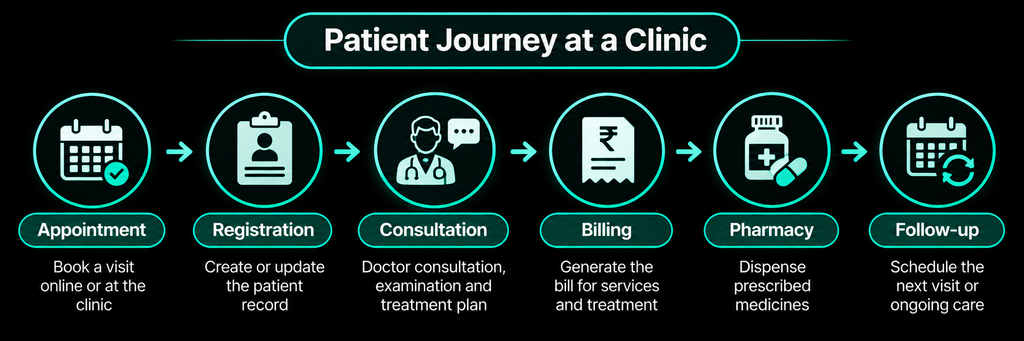
Every vendor’s feature list looks complete. What matters is whether the software fits the way patients actually move through your clinic. Before any demo, spend 30 minutes with your front-desk staff and write down each step:
- Appointment: phone, WhatsApp, walk-in or online booking
- Registration and queue token
- Consultation, notes and prescription
- Billing and payment
- Pharmacy, lab or procedure
- Follow-up reminder
Next to each step, note where time is lost today. For a three-doctor clinic in Kukatpally, the answer might be a long queue at registration, prescriptions the pharmacy can’t read, and stock that runs out without warning. Those bottlenecks are your shortlist criteria. Everything else is secondary.
Core features to check
Appointments and queue
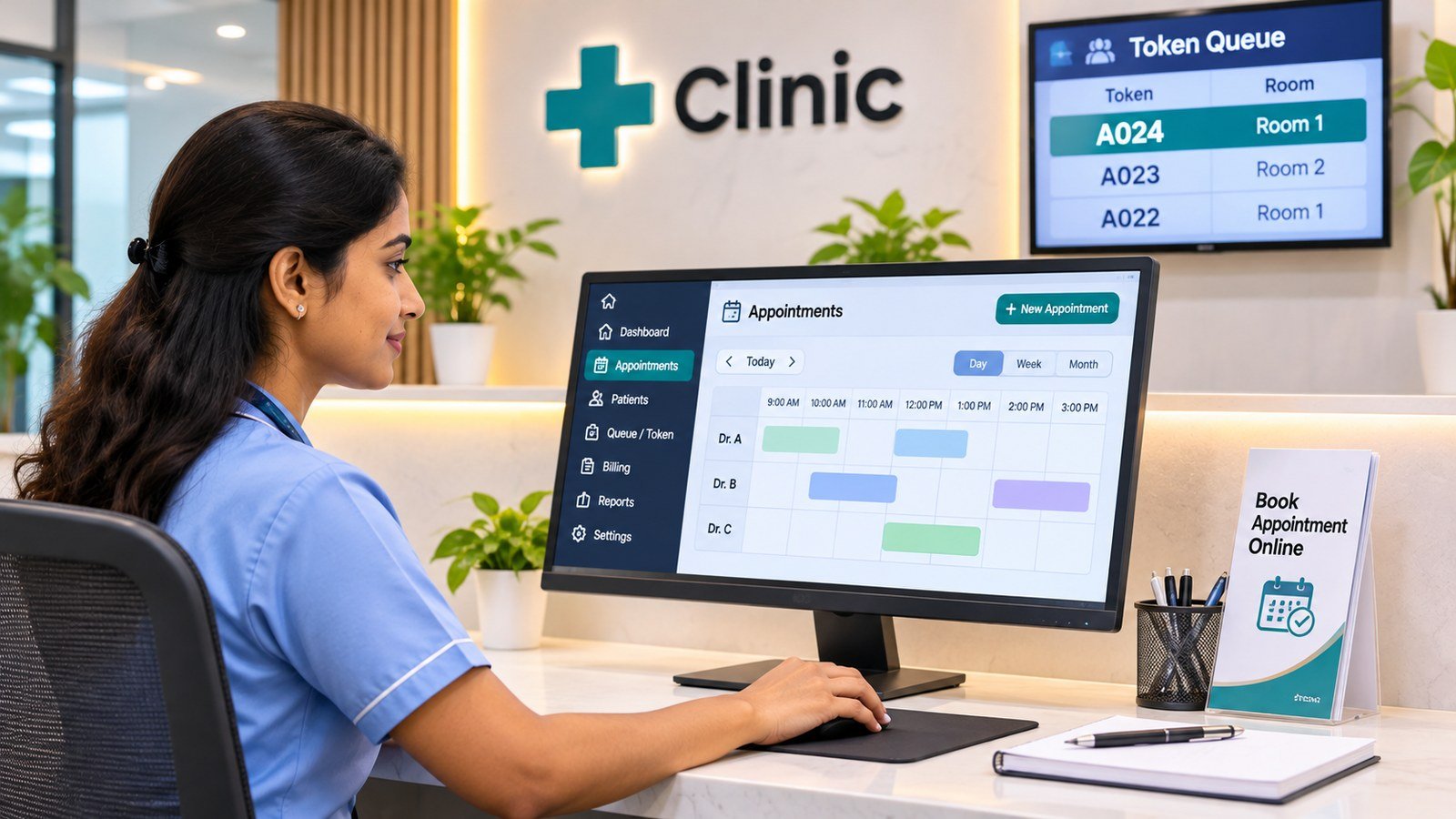
Look for online booking, automatic SMS or WhatsApp reminders, and a token system for walk-ins that shows the doctor who is waiting. Ask whether reminder messages cost extra per message; for busy clinics this adds up.
Patient records and prescriptions
The electronic medical record should hold visit history, diagnoses, prescriptions, allergies and attachments such as lab reports. Prescription templates for your common conditions save doctors the most time. If you’re unsure how far records should go, our guide to EMR vs EHR for Indian clinics explains the difference and why ABDM matters.
Billing
Billing should handle consultation fees, procedures, packages, partial payments, refunds and UPI or card receipts. Discounts should need a manager’s approval and be logged.
Check how the software treats GST. Health care services by a clinical establishment or an authorised medical practitioner are exempt under entry 74 of Notification No. 12/2017-Central Tax (Rate). Several advance rulings have treated medicines supplied to in-patients as part of that exempt service, while pharmacy sales to out-patients have been held taxable. Your software needs to tell these apart. Confirm the treatment for your clinic with your chartered accountant.
Pharmacy and inventory
If you run an in-house pharmacy, you need batch and expiry tracking, low-stock alerts and purchase entries. Schedule H1 compliance matters too. Under Rule 65(3)(h) of the Drugs Rules, each Schedule H1 sale must be recorded in a separate register with the prescriber’s name and address, the patient’s name, the drug and the quantity supplied. The government’s TB programme guidance advises keeping these records for three years. Good software builds that register automatically as you bill.
Reports, staff and access
You should be able to see daily collections, doctor-wise revenue, pending payments and stock value without exporting to Excel. Each user should see only what their role needs: reception, doctors, pharmacy and accounts. Every change to a bill or record should be logged with who made it.
More than one branch?
If you have, or plan, a second location, insist on one patient record across branches, branch-wise billing and stock, and a single owner dashboard. Retrofitting multi-branch support later rarely works well.
India-specific checks
- ABDM. Ask which ABDM integration milestones the product has cleared. Software that can verify a patient’s ABHA and share records with consent will matter more each year.
- Giving patients their records. Under the Indian Medical Council (Professional Conduct, Etiquette and Ethics) Regulations, 2002, records requested by a patient, an authorised attendant or legal authorities must be issued within 72 hours. Check how quickly the software prints or exports a complete patient file.
- Teleconsultations. If you consult by phone or video, the Telemedicine Practice Guidelines, 2020 expect the same documentation as in-person visits, including case history, reports and copies of prescriptions. The software should record teleconsults in the same patient file.
- Data protection. The Digital Personal Data Protection Rules, 2025 are being phased in, with the main obligations due by mid-May 2027. Ask how the vendor handles consent, encryption and access control.
- Security incidents. CERT-In’s 2022 directions require service providers and body corporates to report cyber incidents within six hours of noticing them and to keep system logs for 180 days in India. Ask your vendor what their incident process is and how they would tell you.
Cloud or on-premise?
| Cloud | On-premise | |
|---|---|---|
| Upfront cost | Lower; usually a monthly or yearly subscription | Higher; licence plus a local server |
| Internet needed? | Yes, unless the software has an offline mode | No, for use inside the clinic |
| Backups and updates | Handled by the vendor | Your responsibility |
| Access from home or other branches | Built in | Needs extra setup |
| Where data lives | Vendor’s servers; ask which country | Your premises |
For most small and mid-sized clinics, cloud is easier to run, provided your internet is reliable or the software keeps working offline and syncs later. Ask to see that offline mode in the demo, not just hear about it.
Understand the real cost
Compare the total cost over three years, not the monthly price. Ask each vendor about:
- How pricing works: per doctor, per branch, per user or flat
- One-time setup, data migration and training charges
- SMS and WhatsApp message charges
- Paid add-on modules such as pharmacy, lab or patient app
- Hardware you’ll need, such as receipt printers or barcode scanners
- How much the price can rise at renewal
- What it costs to export your data if you leave
10 things to do in the demo
- Run your real workflow: register a new patient, prescribe, bill and dispense, while someone times it.
- Ask the receptionist who will use it daily to try it, not just the owner.
- Print a prescription and a bill on your own printer format.
- Check prescription printing in Telugu, Hindi or other languages your patients read, if you need it.
- Test it on the computer or phone your staff already use.
- Ask for the ABDM milestones cleared, with proof.
- Ask to see a full data export.
- Ask about support hours, languages and response times, and get them in the contract.
- Ask for two references from clinics of your size and speciality, ideally in your city, and call them.
- Ask for a trial with a sample of your own data before you sign.
A 30-day rollout plan
- Week 1: Set up doctors, fee schedules, procedures, packages and the medicine list. Choose one person to own the system.
- Week 2: Train reception and start with one doctor. Keep the paper register running in parallel.
- Week 3: Move all doctors across. Enter opening pharmacy stock with batch and expiry.
- Week 4: Review reports against your cash and stock. If they match, retire the paper register.
The most common mistakes are buying for features you’ll never use, skipping data migration, giving everyone admin rights and not testing printing until go-live day.
Frequently asked questions
How much does clinic management software cost in India?
Pricing varies widely by model: per doctor, per branch or flat, and by which modules you need. Rather than comparing monthly prices, ask each vendor for the total cost over three years, including setup, migration, messages, add-ons and renewal increases.Is free clinic software good enough?
It can be for a single doctor with simple needs. The government’s ABDM materials mention eSushrut@Clinic, a lightweight system from C-DAC aimed at small clinics. Check support, updates and data export before relying on any free tool.Can we switch software later without losing data?
Only if your current vendor gives you a complete export in a usable format. Ask for a sample export before you sign, and put the export terms in the contract.What if our internet goes down?
On-premise software keeps working inside the clinic. Cloud software needs internet unless it has an offline mode that syncs later. Ask to see the offline mode during the demo.Is patient data safe on the cloud?
It can be safer than a single PC at the front desk, if the vendor encrypts data, controls access by role, logs every change and has a tested backup and incident process. Ask for those answers in writing.
Key takeaways
- Map your patient journey and bottlenecks before you look at any clinic management software.
- Check appointments, records, billing (including GST treatment), pharmacy with Schedule H1 records, reports and role-based access.
- Run the India-specific checks: ABDM milestones, 72-hour record requests, teleconsult records, DPDP and incident reporting.
- Compare three-year total cost, not monthly price, and get data export terms in the contract.
- Roll out over four weeks, with paper running in parallel until the reports match.
If you’re comparing options, CareDesk360 is Ridgeveda’s clinic and hospital management software. Bring your workflow map to a walkthrough and we’ll show you how it would fit, step by step. You can also read more on the CareDesk360 page.
Sources
- Central Board of Indirect Taxes and Customs, Notification No. 12/2017-Central Tax (Rate), 28 June 2017, entry 74 (health care services), as summarised in advance rulings including Rajarajeswari Hospitals, Tamil Nadu AAR, 29 January 2026.
- Drugs Rules, 1945, Rule 65(3)(h) (Schedule H1 register).
- National TB Elimination Programme, Schedule H1 guidance for chemists, accessed November 2026.
- National Medical Commission, Indian Medical Council (Professional Conduct, Etiquette and Ethics) Regulations, 2002, regulation 1.3.2.
- Board of Governors in supersession of the Medical Council of India, Telemedicine Practice Guidelines, 25 March 2020.
- Press Information Bureau, “DPDP Rules, 2025 Notified”, 17 November 2025.
- CERT-In, Directions No. 20(3)/2022-CERT-In under Section 70B(6) of the IT Act, 28 April 2022, summary by Mondaq.
- Press Information Bureau, “Ayushman Bharat Digital Mission: India’s Digital Health Backbone”, 6 July 2026.