
A patient walks into a three-doctor clinic in Kukatpally with a plastic folder: two old prescriptions, a lab report from Ameerpet and a discharge summary from a hospital in Guntur. Your receptionist types the essentials into the clinic software. Is that software an EMR or an EHR? And does the difference change anything for you?
The two terms are often used as if they mean the same thing. They don’t, and in India the gap between EMR vs EHR now has a practical edge, because the Ayushman Bharat Digital Mission (ABDM) has made record sharing part of national infrastructure. This article explains the difference in plain terms, what it means for a clinic or small hospital, and the questions to ask before you choose software.
EMR vs EHR: the short answer
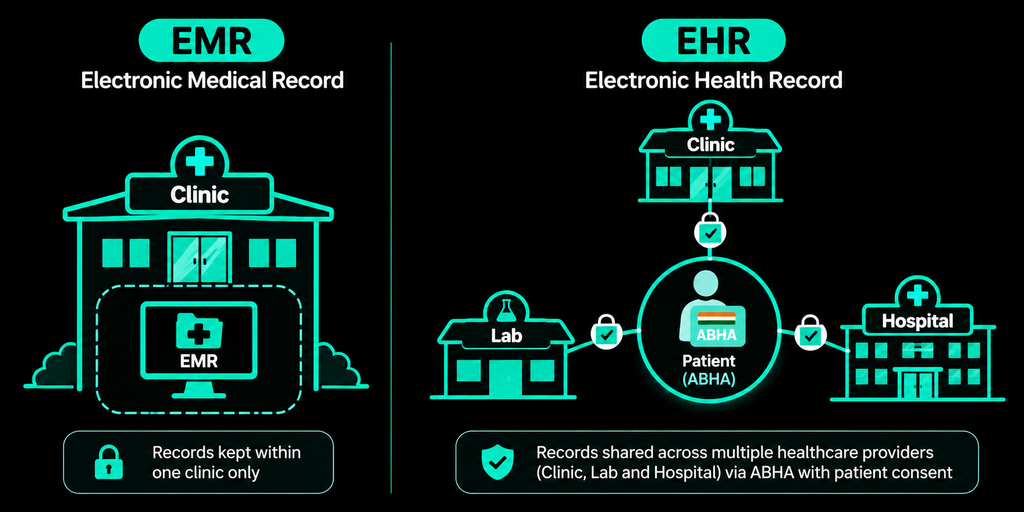
An electronic medical record (EMR) is the digital version of the paper chart in your clinic. It holds the history, diagnoses, prescriptions and notes your own doctors record, and it is used mainly for diagnosis and treatment inside your practice. The catch, as the US Office of the National Coordinator for Health IT points out, is that EMR data does not travel easily outside the practice that created it.
An electronic health record (EHR) does all of that and is also built to share. It is designed to exchange information with other providers, such as labs, specialists and hospitals, so it can hold a fuller picture of the patient’s care from everyone involved, not just your clinic.
Put simply: an EMR is your clinic’s file on a patient. An EHR is the patient’s health story, put together from every place they were treated, with their permission.
The difference, side by side
| Question | EMR | EHR |
|---|---|---|
| Whose records? | One clinic or hospital | The patient, across providers |
| Who adds to it? | Your own doctors and staff | Your team plus labs, specialists and other hospitals |
| Can it be shared? | Usually by printing, PDF or WhatsApp | Electronically, in a standard format, with patient consent |
| Patient access | On request | Often through a patient app or health locker |
| Main purpose | Diagnosis, treatment and follow-up in your practice | Continuity of care wherever the patient goes |
| Example | OPD notes and prescriptions in your clinic software | A Guntur discharge summary you can pull into your consultation in Hyderabad |
Why the difference matters more in India now
ABDM has turned record sharing into national infrastructure
For years, the EHR idea had little practical meaning for most Indian clinics: there was no common way to share records between unconnected providers. ABDM changed that. Each patient can have an Ayushman Bharat Health Account (ABHA), and records created by different providers can be linked to it.
The scale is no longer small. According to a Government of India backgrounder from July 2026, more than 104 crore health records have been linked to over 93 crore ABHA accounts. Sharing is consent-based: using ABDM-enabled software, a facility can create records linked to a patient’s ABHA and, with the patient’s revocable, time-bound consent, see records created elsewhere.
There is a front-desk benefit too. The same backgrounder cites an IIHMR study in which ABDM’s Scan and Share queue tokens cut registration waits from about an hour to 2–5 minutes, with over 23 crore ABHA-linked tokens issued by June 2026.
What “ABDM-enabled” means in practice
Software joins ABDM in stages, called milestones. The three that matter most to a clinic are:
- M1: identity. The software can create or verify a patient’s ABHA at registration.
- M2: sharing your records. Your clinic becomes a Health Information Provider: with consent, it can share the records it creates.
- M3: receiving records. Your clinic becomes a Health Information User: with consent, it can fetch records from other providers.
An EMR that has cleared M1 and M2 starts behaving like part of an EHR network. One that has cleared none of them is still a closed file, however good its screens are. The milestones are cleared by the software vendor, not by your clinic, so this is a question to put to whoever sells you the system.
India has had EHR standards for a decade
The Ministry of Health and Family Welfare first notified Electronic Health Record Standards for India in September 2013 and revised them in December 2016. It also set up the National Resource Centre for EHR Standards (NRCeS) at C-DAC Pune to help software makers adopt them. Standards are what allow one system to read another’s records correctly, which is the whole point of an EHR.
Data protection obligations are arriving
Health records are personal data. The Digital Personal Data Protection (DPDP) Rules, 2025 were notified in November 2025 and are coming into force in phases over 18 months, with the main obligations for organisations that handle personal data due by mid-May 2027. Whether you run an EMR or an EHR, you will need to know where your patient data is stored, who can see it and what happens if it leaks. Your software choice decides much of that.
Does a small clinic need an EHR, or is an EMR enough?
For most clinics, the honest answer is: start with a good EMR inside your clinic software, but make sure it can connect. You don’t need to run a hospital-grade EHR system to benefit from ABDM. What you need is software that can link your records to a patient’s ABHA and share them when the patient agrees.
- Solo doctor: a simple EMR with prescriptions, visit history and billing usually covers the day. ABHA verification at registration is a useful extra, not a must on day one.
- Multi-speciality clinic (2–15 doctors): one shared patient record across departments matters more than anything else. Ask about ABDM milestones before you sign, because changing systems later is painful.
- Hospital (25+ beds): referrals, lab results and discharge summaries move in and out every day. Being able to send and receive records (M2 and M3) saves real staff time.
If budget is the main constraint, look at all your options. The government’s own backgrounder mentions eSushrut@Clinic, a lightweight system from C-DAC aimed at small clinics. The government also runs a Digital Health Incentive Scheme for facilities that create ABHA-linked records, so check the current eligibility rules on the ABDM website.
8 questions to ask before you choose clinic software
- Which ABDM milestones has your product cleared? Ask for M1, M2 and M3 specifically, and for proof.
- Can my front desk create and verify ABHA at registration? Ask whether it supports Scan and Share queue tokens.
- Can I export all my patient data at any time, in a standard format? If you leave, you need your records, not screenshots.
- Which data standards do you follow? A vendor serious about EHR will name them without hesitation.
- Can I control who sees what? Reception, doctors, pharmacy and accounts should each see only what their role needs, and every edit should be logged.
- Where is the data stored, and how is it backed up? Ask about encryption, backup frequency and how they would tell you about a breach.
- Can I give patients their records quickly? Indian rules require records to be supplied within 72 hours of a request (see the FAQ below).
- What happens to my data if I stop paying? Get the answer in the contract, not on a call.
Frequently asked questions
Is an EMR the same as an EHR?
No. An EMR is a digital chart used inside one clinic or hospital. An EHR is built to share information across providers, so it can bring together records from labs, specialists and hospitals with the patient’s consent.
Do private clinics have to join ABDM?
Government material describes ABDM as open to all public and private facilities, including clinics, labs and pharmacies. If your facility is empanelled under a government health scheme such as PM-JAY, check that scheme’s current requirements, as they may differ.
How long must a clinic keep patient records?
Under the Indian Medical Council (Professional Conduct, Etiquette and Ethics) Regulations, 2002, which the NMC kept in force when it put its 2023 conduct regulations on hold, doctors must keep records of indoor patients for three years from the start of treatment. Records requested by a patient, an authorised attendant or legal authorities must be issued within 72 hours. Many hospitals keep records longer for medico-legal reasons, so check any state rules that apply to you.
Can we move from paper to an EMR without losing old records?
Yes, but plan it. Most clinics enter active patients’ key history first and scan older files as attachments. Ask your vendor how they import existing data and what they do with records that don’t map cleanly.
Is an EHR more secure than an EMR?
Not automatically. Security depends on how the software controls access, encrypts and backs up data, and records who changed what. An EHR shares more, so its consent and access controls matter even more.
Key takeaways
- An EMR is your clinic’s digital chart. An EHR is the patient’s record across providers, shared with consent.
- In India, ABDM is what turns an EMR into part of an EHR network, through milestones M1, M2 and M3.
- Most small clinics don’t need a separate EHR system. They need EMR software that can link to ABHA and share records.
- Ask vendors about ABDM milestones, data export, access control and data protection before you sign. The DPDP Rules’ main obligations apply from May 2027.
If you’re comparing clinic software, take these eight questions to every demo. CareDesk360 is Ridgeveda’s clinic and hospital management software, and we’re happy to walk through how it would fit your practice. Book a walkthrough or read more on the CareDesk360 page.
Sources
- Office of the National Coordinator for Health IT (HealthIT.gov), “EMR vs EHR – What is the Difference?”, published 4 January 2011, updated 31 March 2026.
- Press Information Bureau, Government of India, “Ayushman Bharat Digital Mission: India’s Digital Health Backbone”, 6 July 2026.
- National Health Authority, Ayushman Bharat Digital Mission (ABDM integration milestones and Digital Health Incentive Scheme), accessed November 2026.
- Ministry of Health and Family Welfare, Electronic Health Record Standards for India, 2016, notified 30 December 2016.
- C-DAC, National Resource Centre for EHR Standards (NRCeS), accessed November 2026.
- Press Information Bureau, “DPDP Rules, 2025 Notified”, 17 November 2025.
- National Medical Commission, Indian Medical Council (Professional Conduct, Etiquette and Ethics) Regulations, 2002, regulations 1.3.1 and 1.3.2.