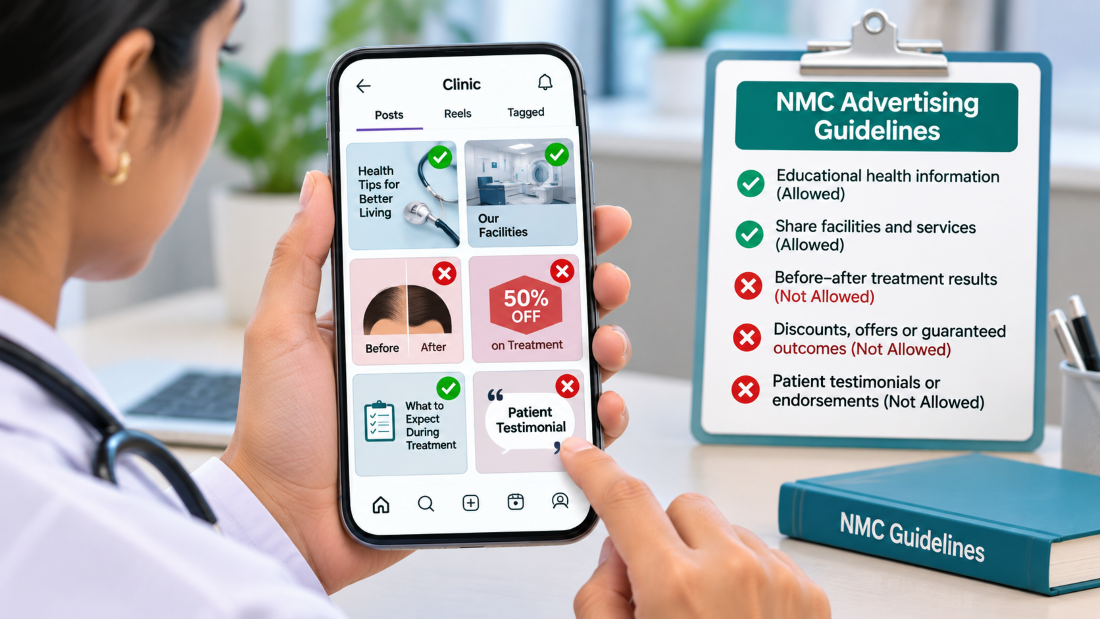
Scroll through a typical clinic’s Instagram and you’ll often find a before-and-after carousel, a “best dentist in Kukatpally” reel, a festive discount and a patient’s video review. Since 6 October 2026, every one of those carries regulatory risk.
That day, the National Medical Commission (NMC) issued its NMC advertising guidelines 2026, formally the Guidelines on Ethical Advertising and Public Communication by Hospitals/Medical Institutions and Registered Medical Practitioners. They apply to doctors and hospitals alike and cover social media, websites, search, influencers and AI-generated content. This article sets out what the guidelines say, who they apply to, what you can still post, and how to check your clinic’s accounts.
What the NMC issued, and when it applies
The guidelines were issued by the NMC’s Ethics and Medical Registration Board as a public notice (No. R-13014/01/2024-Ethics) dated 6 October 2026, and came into force with immediate effect. There is no transition period. They were framed in the context of a writ petition before the Supreme Court about unethical advertising by hospitals (Writ Petition (Civil) No. 1160/2023).
The guidelines don’t replace the Indian Medical Council (Professional Conduct, Etiquette and Ethics) Regulations, 2002. They work alongside them and the NMC Act, 2019, and say plainly that nothing in them permits what existing law already prohibits (clauses 2.1(f) and 2.2).
Who the rules apply to: doctors and hospitals
| Registered medical practitioners (RMPs) | Hospitals and medical institutions | |
|---|---|---|
| Read together with | NMC Act, 2019 and the 2002 Regulations (cl. 4.2) | Clinical Establishments Act, 2010 or the applicable State Act (cl. 4.3) |
| What they may say | Health education, formal announcements and other listed exceptions (cl. 8.2) | Factual, verifiable information about the facility (cl. 8.3 and 9.1) |
| Who takes action | The State Medical Council (cl. 10.1) | The authority under the Clinical Establishments Act or State Act (cl. 10.1, 11.5) |
One clause matters for every practice that works with a marketing agency. Under clause 4.4, using a platform, agency or influencer does not, by itself, remove a doctor’s or hospital’s responsibility for content they authorised, commissioned, sponsored or knowingly allowed. If your agency posts it on your page, it’s your post.
What counts as an “advertisement”
The definition is broad (clause 3.2). Any communication that directly or indirectly promotes a doctor’s or institution’s services, skills, reputation, achievements or facilities counts, in any medium. That includes sponsored and targeted posts, influencer content, search-engine promotion and AI-generated or AI-assisted content, if it has a promotional character.
Two exemptions are important:
- Public-interest information with no promotional intent or commercial benefit is not an advertisement (Explanation I).
- Factual information about equipment, technology or services is allowed, as long as it makes no superiority, guaranteed-outcome, comparative or unverifiable claims (Explanation II).
What is prohibited
Clause 8.1 lists the restrictions on doctors, and clause 8.3(ii) applies the same spirit to hospitals. The ones that affect everyday clinic marketing most are:
- Testimonials and reviews. No fake, paid or misleading reviews, ratings or testimonials. Doctors may not request or share patient testimonials or reviews to promote themselves on social media (Explanation V; cl. 8.1(xi)).
- Before-and-after photos and success stories. Prohibited for promotion. The only exception is scientific or educational use with anonymised consent (cl. 8.1(v)). Patient consent alone does not make a prohibited post acceptable (cl. 6.2).
- Exaggerated claims. The guidelines give examples: “guaranteed cures”, “best doctors”, “100% success”, “painless treatment” and “miracle treatment” (cl. 8.1(iii)).
- Superiority claims. Words like “best”, “No.1”, “leading” or “most trusted” are allowed only if objectively verifiable with a transparent method. Awards must disclose the awarding body, date and conditions where needed (cl. 8.1(ix)).
- Offers and inducements. No discounts, limited-period offers, contests, coupons, cashbacks, referral benefits or free procedures that encourage unnecessary consultations or tests (cl. 8.1(x)).
- Fear-based marketing that creates unnecessary demand for procedures or diagnostics (cl. 8.1(i)).
- Fake engagement. No bought followers, likes, reviews, comments or views, and no gaming of search rankings (cl. 8.1(xii)).
- Pay-per-patient arrangements. Agency, digital marketing, influencer or platform contracts must not link payment to the referral of individual patients (cl. 8.1(viii)).
- Patient identity. No publicly identifiable patient data, such as names or faces (cl. 7.4). Where disclosure is lawful, identifying features must be cropped or blurred (cl. 6.4).
- AI-generated promotion. Commercial AI-generated promotional campaigns are prohibited. AI must not create synthetic testimonials or alter a patient’s image or outcome, and permitted AI content must be labelled as AI-generated (cl. 7.2).
- Doctor photos used for self-promotion (cl. 9.2).
What you can still post
The NMC has not banned doctors or hospitals from social media. The guidelines explicitly allow:
- Health education. Awareness content, public health campaigns and academic discussion, provided it doesn’t promote your practice, solicit patients or get monetised through promotional marketing (cl. 5.1).
- Formal announcements of starting a practice, a change of address or practice type, temporary absence, resuming practice, and a public declaration of charges (cl. 8.2(ii), 9.3).
- Talks and lectures on public health, in the doctor’s own name and designation, without promoting the employer (cl. 8.2(iii)).
- Patient education pamphlets at the clinic, without cure guarantees or superiority claims (cl. 8.2(iv)).
- Greetings on national days or medical occasions, if they don’t advertise professional gain (cl. 8.2(v)).
- For hospitals: factual, verifiable information about the name, location, contact details, departments, facilities, equipment, emergency services, accreditation and charges (cl. 8.3(i), 9.1). A website doctor directory listing names, qualifications, specialities, registration details and availability is treated as patient information, not promotion (cl. 9.1).
Educational vs promotional: four rewrites
| Risky post | Safer alternative |
|---|---|
| “Best root canal specialist in Hyderabad” | “Root canal treatment: what happens at each visit” |
| “Flat 30% off on dental implants this Diwali” | A factual note of consultation charges, with no deadline or discount |
| Patient video: “Dr. X cured my back pain in one session” | The doctor explaining typical recovery after a procedure, with no patient shown |
| Before-and-after smile makeover carousel | An illustrated explainer of how veneers are fitted |
Disclosures every post now needs
- A doctor posting on electronic media must show their name, qualifications, registration status and State or National Medical Register number (Explanation III).
- A clinic or hospital posting must disclose the same details for the doctors involved (Explanation IV).
- Permitted AI-generated content must carry a mark saying it is AI-generated (cl. 7.2).
- Any material commercial relationship in public-health communication must be disclosed (cl. 8.1(xi)).
Penalties
For doctors, the State Medical Council can act in stages, but only after a show-cause notice and a chance to respond (cl. 10.1–10.3):
| Violation | Action |
|---|---|
| First | Warning and mandatory ethics training |
| Second | Censure and a monetary penalty |
| Third | Suspension of registration for 3–6 months |
| Serious (e.g. misleading cure claims, patient inducement, digital mass solicitation) | Suspension for 6–12 months |
| Repeated | Removal from the register for 1–3 years |
Hospitals are dealt with under the Clinical Establishments Act or the relevant State Act. A doctor personally involved in a hospital’s prohibited post can also be examined separately (cl. 11.5). Appeals lie to the NMC’s Ethics and Medical Registration Board within 60 days (cl. 11.1).
Other laws that still apply
- Consumer protection. The Central Consumer Protection Authority’s Guidelines for Prevention of Misleading Advertisements and Endorsements, 2022 require claims to be capable of substantiation. The CCPA can impose penalties of up to ₹10 lakh, and up to ₹50 lakh for repeat contraventions.
- ASCI influencer rules. Influencers giving technical health advice must be qualified and disclose those qualifications upfront.
- Data protection. Advertising that uses personal data must comply with the IT Act, 2000 and the Digital Personal Data Protection Act, 2023 and its 2025 Rules (cl. 7.6). For how patient data rules are changing, see our article on EMR vs EHR for Indian clinics.
A 30-minute audit of your clinic’s social media
- Archive or delete before-and-after posts, patient success stories and testimonial videos.
- Search your captions and bio for “best”, “No.1”, “guaranteed”, “painless” and “100%”. Remove them unless you can prove them with a transparent method.
- Stop sharing Google reviews and patient messages as posts or stories.
- Remove discount, festive offer, coupon and “free check-up” posts that push consultations or tests.
- Add each doctor’s name, qualifications and SMC/NMR registration number to the bio and to posts featuring them.
- Label any AI-generated images or videos, and stop using AI for promotional campaigns.
- Check your agency and influencer contracts. Payment must not be tied to individual patients or leads converted into patients.
- Make sure no post shows a patient’s face, name or identifying marks.
Frequently asked questions
Can I repost my Google reviews on Instagram?
Doctors should not. The guidelines say doctors may not request or share patient testimonials or reviews to promote themselves on social media (Explanation V to clause 3.2). Letting reviews sit on your Google Business Profile is different from republishing them as promotion.Can individual doctors run paid social media ads?
Sponsored and targeted posts count as advertising (cl. 3.2), and doctors are prohibited from direct or indirect patient solicitation and self-promotion (cl. 8.1(ii)). Paid promotion of an individual doctor’s practice is therefore high risk. Hospitals may advertise factual, verifiable information about their facilities (cl. 8.3(i)). Take legal advice before running paid campaigns.Can a hospital show its doctors’ photos?
A website directory of doctors with names, qualifications, specialities, registration details and availability is treated as patient information (cl. 9.1). Using a doctor’s photo for self-advertisement or promotional publicity is not permitted (cl. 9.2), and hospitals must not promotionally portray an individual doctor (cl. 8.3(ii)).Do these guidelines apply to dentists and AYUSH practitioners?
The rules for individual practitioners apply to doctors registered under the NMC Act (cl. 3.7). Dentists and AYUSH practitioners have their own regulators and codes, so check those. The hospital provisions cover clinical establishments in any recognised system of medicine (cl. 3.4), so a multi-speciality hospital’s advertising falls within them.Is a “free health camp” post allowed?
Free procedures and inducements that encourage unnecessary consultations or tests are prohibited (cl. 8.1(x)). A genuine public health awareness activity is treated differently (cl. 5.1), so keep the post focused on awareness, not on bringing patients into your practice.
Key takeaways
- The NMC advertising guidelines 2026 took effect on 6 October 2026, with no transition period.
- Testimonials, before-and-after photos, unverifiable “best” claims, discounts and fake engagement are out.
- Health education, formal announcements and factual hospital information are still allowed.
- Every post needs the doctor’s name, qualifications and registration number. AI content must be labelled.
- Using an agency doesn’t shift responsibility, and agency fees must not be tied to individual patients.
Before your next post goes live, you can run it through the free CareDesk360 medical content checker, which reviews posts and ads against NMC rules. If you’d like help rebuilding your clinic’s content around patient education, talk to the Ridgeveda team.
This article is general information, not legal advice. Check the current NMC notices before publishing patient-facing content.
Sources
- National Medical Commission, Ethics and Medical Registration Board, Public Notice No. R-13014/01/2024-Ethics: Guidelines on Ethical Advertising and Public Communication by Hospitals/Medical Institutions and Registered Medical Practitioners, 6 October 2026 (copy hosted by Medical Dialogues).
- National Medical Commission, Indian Medical Council (Professional Conduct, Etiquette and Ethics) Regulations, 2002.
- Central Consumer Protection Authority, Guidelines for Prevention of Misleading Advertisements and Endorsements for Misleading Advertisements, 2022, notified 9 June 2022.
- Advertising Standards Council of India, Guidelines for Influencer Advertising in Digital Media, updated April 2025.
- Medical Dialogues, “NMC issues ethical advertising, public communication guidelines for doctors, hospitals”, 7 October 2026.