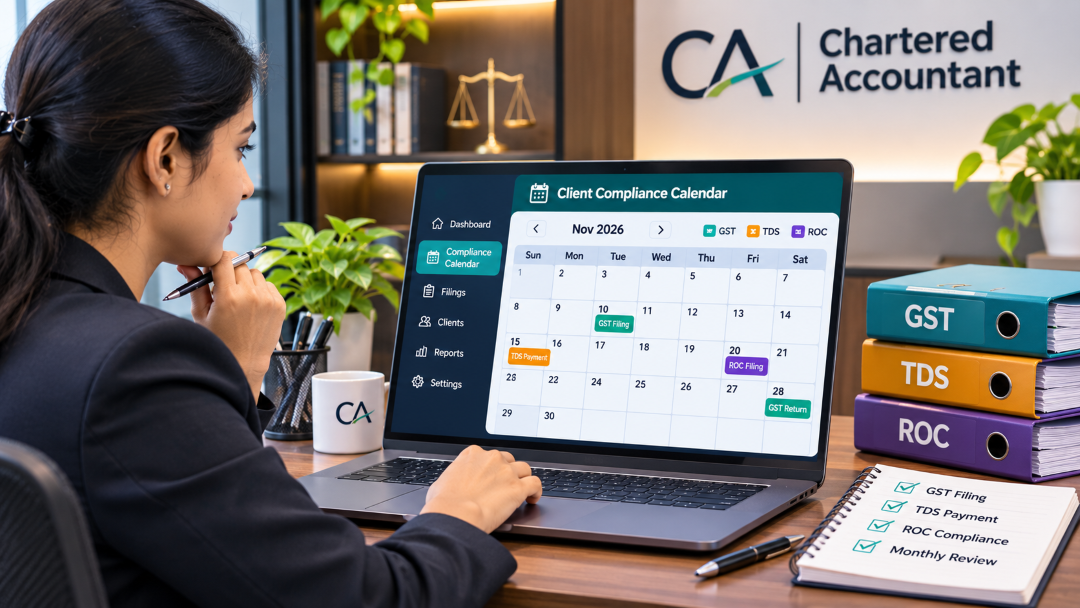
November is a heavy month for any CA firm. Income tax returns for audit cases are due on 21 November 2026 after this year’s extension, annual returns (MGT-7) for companies that held their AGM on 30 September fall due on 29 November, and GSTR-3B and TDS deposits keep arriving on their usual dates. For a firm with 150 clients, that can mean several hundred separate filings in one month.
This guide explains how to build a compliance calendar for CA firms that holds every client’s deadlines in one place: which dates it must cover, what changed in Tax Year 2026-27 under the new Income-tax Act, how to turn the calendar into assigned work, and what to look for if you move it into practice management software.
Why spreadsheets stop working
Most firms start with an Excel sheet: one row per client, one column per return. It works with 30 clients. Around 100, it starts to break.
- Each partner keeps their own copy, so nobody sees the whole month.
- A tick doesn’t show where a filing really is, for example “documents still pending from the client” or “prepared, waiting for review”.
- Chasing documents happens on WhatsApp and email, outside the sheet, so delays are invisible until the last two days.
- Billing is disconnected. Filed work sits unbilled because nothing links a completed return to an invoice.
Misses are also getting harder to fix. Since December 2025 the GST portal has blocked any return filed more than three years after its original due date.
The recurring deadlines your calendar must hold
These are the standard dates for Tax Year 2026-27. Extensions are common, so treat this as the base calendar and update it whenever the CBDT, CBIC or MCA announces a change.
| Area | Filing or payment | Usual due date |
|---|---|---|
| GST (monthly filers) | GSTR-1 | 11th of the next month |
| GST (monthly filers) | GSTR-3B | 20th of the next month |
| GST (QRMP, turnover up to ₹5 crore) | GSTR-1 / GSTR-3B | 13th / 22nd or 24th (by state) of the month after the quarter |
| GST (QRMP) | PMT-06 tax payment | 25th of the next month, for the first two months of the quarter |
| TDS | Deposit | 7th of the next month; 30 April for March deductions (non-government) |
| TDS | Quarterly returns | 31 July, 31 October, 31 January and 31 May |
| ROC (companies) | AGM | Within six months of year-end (30 September for a March year-end) |
| ROC (companies) | AOC-4 / MGT-7 or MGT-7A | Within 30 days / 60 days of the AGM |
| Income tax (audit cases) | Tax audit report / return | Extended this year to 21 October / 21 November 2026 (AY 2026-27) |
Two details catch firms out. The ROC dates run from each company’s actual AGM date, so a company that met on 12 September has earlier deadlines than one that met on 30 September. And QRMP clients in different states have different GSTR-3B dates.
What changed in Tax Year 2026-27
The Income-tax Act, 2025 replaced the 1961 Act from 1 April 2026. Three changes affect how a firm runs its calendar:
- “Tax Year” replaces “Assessment Year” and “Previous Year”. The tax year matches the financial year. Update your client masters, task names and templates.
- Forms have new numbers. Form 16 is now Form 130, Form 16A is Form 131, and the quarterly TDS returns have moved to new forms too. Returns for quarters of FY 2025-26 still go on the old forms. The new forms start with Q1 of Tax Year 2026-27.
- TDS deposit timelines did not change. The Income-tax Rules, 2026 keep the 7th-of-the-month rule and the 30 April date for March deductions.
For the next year or so your calendar will hold both kinds of work: corrections and late filings for old-Act periods, and regular filings under the new Act. Label each task with the law and form it falls under, so nobody files on the wrong form.
Building a client-wise compliance calendar
- Create a master record for every client entity: PAN, each GSTIN, TAN, CIN or LLPIN, GST filing frequency (monthly or QRMP), state, audit applicability and AGM date. A group with three companies is three entities.
- Generate the recurring tasks from that record. A monthly GST filer with a TAN gets GSTR-1, GSTR-3B and TDS tasks every month. A QRMP client gets quarterly returns and monthly PMT-06 instead.
- Set an internal due date before the statutory one. Three to five working days ahead leaves room for review and portal problems.
- Give every task a preparer and a reviewer, so the work belongs to named people, not “the team”.
- Track real status, not a tick: documents requested, documents received, in preparation, in review, filed, acknowledgement saved.
- Request documents from the task itself, with automatic reminders, instead of chasing on WhatsApp.
- Store the acknowledgement against the client as soon as a return is filed, then raise or update the invoice.
- Hold a 20-minute review every Monday: what’s due in the next seven days, what’s stuck waiting on clients and who is overloaded.
Look after client data
A CA firm holds some of the most sensitive data its clients have: PAN and Aadhaar details, bank statements, salary data and passwords for government portals. The Digital Personal Data Protection Rules, 2025 are coming into force in phases, with most obligations due by mid-May 2027. In practice that means collecting documents through a controlled upload link rather than personal WhatsApp, giving each staff member access only to the clients they work on, and knowing what you would do if a laptop or account were compromised.
What to look for in CA practice management software
If you’re moving your calendar out of Excel, use this checklist in every demo:
- Does it generate recurring deadlines from each client’s details (monthly vs QRMP, state, audit, AGM date), or do you have to type every one?
- Has it been updated for the Income-tax Act, 2025, including Tax Year labels and the new form numbers?
- Can each task have a preparer, a reviewer and an internal due date?
- Can clients upload documents through a link, with reminders?
- Does it store filing acknowledgements against each client?
- Does it connect work to billing: retainers, one-off jobs and what is still unpaid?
- Can you control access by role and by client, and see who changed what?
- Can you export all your data if you ever leave?
If cost is the main concern, compare paid tools with the practice management software the ICAI offers its members free of cost, before you decide.
Frequently asked questions
What is a compliance calendar for a CA firm?
It is a client-wise schedule of every statutory filing and payment the firm handles, such as GST returns, TDS deposits and returns, ROC filings and income tax returns, with an owner, an internal due date and a status for each one.
Did the Income-tax Act, 2025 change TDS due dates?
The deposit timelines stayed the same: the 7th of the following month, and 30 April for March deductions by non-government deductors. What changed are the section references, the form numbers and the move from Assessment Year to Tax Year.
How far ahead of the statutory date should internal deadlines be?
Most firms work best with three to five working days. That leaves time for a reviewer to check the return, for clients to answer last questions and for portal slowdowns near the due date.
Is Excel enough for a small practice?
For a sole practitioner with a few dozen clients, a well-kept sheet can work. Once several people share the work, or clients have multiple registrations, a shared system with status tracking and reminders usually saves more time than it costs.
Does the DPDP Act apply to CA firms?
The Act applies to anyone who decides how digital personal data is processed, which includes firms that hold clients’ PAN, Aadhaar, bank and salary details. Most obligations under the DPDP Rules, 2025 apply from mid-May 2027, so this is a good time to tighten how documents are collected and who can see them.
Key takeaways
- A compliance calendar for CA firms should be client-wise, built from each entity’s registrations, and show real status, not just ticks.
- Tax Year 2026-27 brings new terms and form numbers under the Income-tax Act, 2025, while TDS deposit dates stay the same.
- ROC and QRMP dates differ from client to client, so generate them from each client’s details rather than one fixed list.
- Set internal deadlines three to five days early, with a named preparer and reviewer for every filing.
- Collect documents through controlled links and limit access by client, ahead of the DPDP obligations in 2027.
ConsultDesk360 is Ridgeveda’s practice management software for CA, CS and tax consultants. It brings together a client workspace, a compliance calendar for GST, TDS, ROC and income tax, task allocation, document requests, billing and filing history. If you’d like to see how it would handle your client list, book a walkthrough.
Sources
- Income Tax Department, CBDT Circular No. 7/2026 (extension of tax audit report and return due dates, AY 2026-27), September 2026.
- Income Tax Department, Tax payments FAQ (TDS deposit timelines under the Income-tax Rules, 2026), accessed November 2026.
- TaxGuru, “Income-tax Act 2025: TDS/TCS forms for deductors” (Tax Year and form transition), 2026.
- TaxGuru, “Key Changes in Income Tax Forms under Income Tax Act 2025” (Form 130 and Form 131), 2026.
- ClearTax, “TDS Return Filing & Payment Due Dates for FY 2026-27”, accessed November 2026.
- SoftwareSuggest, “GST Return Due Dates for 2026–27”, accessed November 2026.
- Treelife, “15 changes in 2026 that every GST-registered business must act on” (three-year filing block), 2026.
- TaxGuru, “Annual ROC compliance 2026: AOC-4 and MGT-7”, 2026.
- Press Information Bureau, “DPDP Rules, 2025 Notified”, 17 November 2025.
- ICAI Board for Small & Medium Practitioners, Practice Management Software for CA practitioners, accessed November 2026.