Author: admin

  • Smile Designing and Braces – Your Guide to a Confident Smile

    Smile Designing and Braces – Your Guide to a Confident Smile

    Your smile is one of the first things people notice. Stained, chipped, crooked or gapped teeth can make you hold back from smiling freely in photos, at work or at family functions.

    Modern dentistry offers several solutions for improving the appearance and alignment of teeth. At Ishanvi Dental Care & Implant Center in Kukatpally, Hyderabad, cosmetic smile designing and orthodontic treatment are planned around your facial features, dental health and personal goals.

    This guide explains the different smile designing treatments, types of braces and aligners, and how to choose the right option for your smile.

    What Is Smile Designing?

    Smile designing, also known as a smile makeover, is a personalised dental treatment plan that focuses on improving the appearance of your smile.

    Rather than using a single procedure, smile designing may combine different cosmetic and restorative dental treatments to achieve the desired results.

    During the planning process, the dentist evaluates the shape, colour and alignment of your teeth, along with your gum line, lips and facial features. Based on this assessment, a suitable treatment plan is recommended.

    What Dental Problems Can Smile Designing Correct?

    Smile designing can address several cosmetic dental concerns that affect the overall appearance of your smile.

    People with yellow or stained teeth may benefit from professional teeth whitening, while chipped, worn or uneven teeth can be improved using dental bonding, veneers or crowns.

    Gaps between teeth, slightly crooked or overlapping teeth, and irregularly shaped teeth may also be corrected through appropriate cosmetic or orthodontic procedures.

    For patients who feel that too much gum tissue is visible when smiling, gum contouring may help improve the balance between the teeth and gums.

    Smile designing can also include replacing missing teeth with dental implants or bridges, depending on the patient’s oral health and treatment requirements.

    Different Treatments Used in Smile Designing

    A smile makeover may involve one or more dental procedures. The choice of treatment depends on the condition of the teeth, the patient’s expectations and the dentist’s recommendations.

    TreatmentWhat It DoesTypical Time
    Teeth whiteningLightens natural tooth colourOne visit, about an hour
    Composite bondingRepairs chips and closes small gaps using tooth-coloured resinOne visit
    Dental veneersThin shells bonded to the front of teeth to improve colour and shapeTwo to three visits
    Dental crownsCover badly damaged or discoloured teethTwo to three visits
    Gum contouringReshapes the gum line, often using a dental laserOne visit
    Braces or alignersStraighten teeth and correct bite alignmentSeveral months to two years
    Dental implants or bridgesReplace missing teethVaries

    The duration of treatment may vary depending on individual dental conditions and the complexity of the procedure.

    How Is a Smile Makeover Planned?

    A successful smile makeover begins with a detailed consultation and evaluation of your oral health.

    Initial Consultation: The dentist discusses your concerns, expectations and the changes you would like to make to your smile.

    Dental Examination: Your teeth, gums and bite are examined. Photographs, dental X-rays, impressions or digital scans may be taken to understand your dental structure.

    Personalised Treatment Plan: Based on the examination, the dentist recommends suitable procedures and explains the expected treatment duration and cost.

    Oral Health Preparation: Existing dental problems such as cavities or gum disease are treated before cosmetic procedures begin.

    Treatment and Follow-Up: The planned dental procedures are completed, followed by instructions on maintaining your results through proper oral hygiene and regular dental visits.

    Orthodontic Treatment: More Than Just Straight Teeth

    Orthodontic treatment focuses on correcting the position and alignment of teeth.

    Although braces are commonly associated with improving the appearance of a smile, orthodontic treatment can also improve bite function and make teeth easier to clean.

    People with crowded or crooked teeth, gaps between teeth, protruding front teeth, or bite problems such as overbite, underbite and crossbite may benefit from orthodontic evaluation.

    In some cases, orthodontic treatment may also help patients who experience difficulty biting or chewing properly.

    At Ishanvi Dental Care & Implant Center, the appropriate treatment option can be discussed after evaluating your teeth, gums and bite alignment.

    Types of Braces and Clear Aligners

    Modern orthodontics offers different teeth-straightening options to suit individual dental requirements, lifestyle preferences and budgets.

    Metal Braces

    Metal braces use brackets and wires to gradually move teeth into their correct positions.

    They are a commonly used orthodontic treatment option and are generally effective for correcting a wide range of alignment and bite problems.

    Metal braces are also typically more economical than some other orthodontic options.

    Ceramic Braces

    Ceramic braces work similarly to traditional metal braces but use tooth-coloured brackets that are less noticeable.

    They are often preferred by patients who want a more discreet appearance while undergoing orthodontic treatment.

    However, ceramic braces may require additional care to prevent staining and maintain their appearance.

    Clear Aligners

    Clear aligners are nearly invisible, removable trays designed to gradually move teeth into better alignment.

    Unlike fixed braces, clear aligners can be removed while eating, brushing and flossing.

    However, they must be worn for most of the day as instructed by the dentist to achieve the planned results.

    Metal Braces vs Ceramic Braces vs Clear Aligners
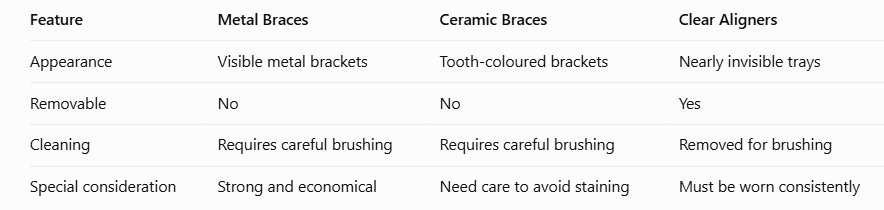
    Your dentist will recommend the most suitable orthodontic treatment based on your dental condition, lifestyle and budget.

    Am I Too Old for Braces?

    Many adults believe that braces are only suitable for children and teenagers. However, orthodontic treatment can be performed at different ages as long as the teeth, gums and supporting bone are healthy.

    Adults who prefer a less noticeable treatment option may consider ceramic braces or clear aligners.

    For children, an orthodontic evaluation around the age of seven can help identify developing alignment or bite problems at an early stage.

    The ideal treatment approach depends on the patient’s dental health and orthodontic requirements.

    Life With Braces: Simple Tips for Better Results

    Maintaining good oral hygiene is particularly important during orthodontic treatment.

    Patients wearing braces should brush carefully after meals and use interdental brushes to clean around brackets and wires. Hard and sticky foods such as nuts, chikki and chewing gum should be avoided because they may damage orthodontic appliances.

    Hard fruits should be cut into smaller pieces rather than bitten directly.

    Attending scheduled orthodontic adjustment appointments is also important for monitoring treatment progress.

    After completing orthodontic treatment, retainers should be worn as instructed to help prevent teeth from shifting back towards their previous positions.

    How to Keep Your New Smile Bright

    Maintaining the results of smile designing and orthodontic treatment requires consistent oral care.

    Brush your teeth twice daily and clean between your teeth regularly to prevent plaque accumulation.

    Limit frequent consumption of tea, coffee and strongly coloured beverages, or rinse your mouth with water after consuming them.

    Avoid tobacco products, which can contribute to tooth staining and gum problems.

    Regular professional dental cleanings, generally every six months depending on your oral health needs, can help maintain healthy teeth and gums.

    Patients who grind their teeth may also benefit from a night guard if recommended by their dentist.

    Frequently Asked Questions

    How long does orthodontic treatment take?

    Most orthodontic treatments take approximately 12 to 24 months. However, mild alignment corrections may require less time, while complex cases may take longer.

    Is teeth whitening safe?

    Professional teeth whitening is generally safe when performed or supervised by a qualified dentist. Some patients may experience temporary tooth sensitivity, which usually settles within a few days.

    Do dental veneers damage natural teeth?

    Traditional dental veneers usually require the removal of a thin layer of enamel to create space for the veneer. Your dentist will explain whether veneers or a more conservative treatment option is appropriate for your teeth.

    How long do smile makeover results last?

    The longevity of smile makeover treatments depends on the procedures performed and how well the teeth are maintained. Teeth whitening results may last approximately one to three years, while veneers and crowns can last ten years or longer with appropriate care.

  • Root Canal Treatment – A Painless Way to Save Your Tooth

    Root Canal Treatment – A Painless Way to Save Your Tooth

    Few words worry patients as much as “root canal”. The fear comes from old stories. With modern anaesthesia and techniques, root canal treatment is no more uncomfortable than getting a filling, and it relieves pain instead of causing it.

    At Ishanvi Dental Care & Implant Center in Kukatpally, Hyderabad, root canal treatment and dental restorations are used to save natural teeth wherever possible. Here is what you need to know.

    What Is a Root Canal Treatment?

    Inside every tooth is a soft core called the pulp, which contains nerves and blood vessels. When decay or injury reaches the pulp, it becomes infected and painful.

    In root canal treatment (RCT), the dentist removes the infected pulp, cleans and shapes the canals inside the roots, and seals them with a filling material. The tooth is then restored with a filling or crown. The tooth stays in your mouth and continues to work normally.

    Signs You May Need a Root Canal

    A tooth infection can develop gradually, and the symptoms may differ from person to person. Common warning signs include severe or throbbing toothache, especially at night, lingering sensitivity to hot or cold foods, and pain while chewing or biting.

    Some patients may notice swelling of the gums or face, a small pimple-like boil on the gum, or a tooth that has turned darker than the surrounding teeth. Deep cavities and cracked teeth can also indicate damage that may require root canal treatment.

    Sometimes, an infected tooth causes no pain at all and is discovered only during a dental X-ray.

    The Root Canal Procedure: Step by Step

    Root canal treatment involves several stages designed to remove infection and preserve the natural tooth.

    Examination and X-ray: The dentist first examines the affected tooth and takes an X-ray to assess the extent of the infection.

    Local Anaesthesia: The tooth and surrounding area are numbed using local anaesthesia to minimise discomfort during treatment.

    Cleaning the Root Canals: A small opening is created in the tooth to remove the infected pulp. The root canals are then carefully cleaned and disinfected.

    Filling the Canals: Once the canals are cleaned, they are sealed using a rubber-like material called gutta-percha.

    Final Restoration: The tooth is rebuilt with a filling, and a dental crown is placed to protect it from further damage.

    Many root canal treatments can be completed in one or two visits, depending on the severity of the infection.

    Why Is a Dental Crown Usually Needed After Root Canal Treatment?

    A root-canal-treated tooth, particularly a back tooth, may become more vulnerable to fractures caused by everyday chewing pressure.

    A dental crown acts like a protective cap, covering the treated tooth and helping restore its strength and function.

    Depending on the patient’s requirements, dentists may recommend metal-ceramic crowns, all-ceramic crowns or zirconia crowns that closely resemble natural teeth.

    What Happens If You Delay Root Canal Treatment?

    Ignoring an infected tooth can lead to more serious dental problems. As the infection progresses, it may spread into the surrounding bone and form a dental abscess.

    Pain and swelling can become more severe, and the tooth may gradually deteriorate until it can no longer be restored. In such cases, extraction may become necessary, followed by tooth replacement using a dental implant, bridge or denture.

    Painkillers and antibiotics may provide temporary relief in some situations, but they do not remove the infected pulp inside the tooth.

    Seeking dental care early can improve the chances of preserving your natural tooth.

    Dental Restorations: Fixing Teeth Before They Need a Root Canal

    Not every damaged or decayed tooth requires root canal treatment. When dental problems are identified early, restorative procedures can often repair the tooth before the infection reaches the pulp.

    Different dental restorations are recommended depending on the extent of the damage.

    RestorationWhen It Is Used
    Tooth-coloured composite fillingSmall to medium cavities and chipped front teeth
    Glass ionomer fillingCavities near the gum line and children’s teeth
    Inlay or onlayLarger cavities where a regular filling may not be strong enough
    Dental crownBadly broken teeth or teeth following root canal treatment

    Root Canal Treatment vs Tooth Extraction: Which Is Better?

    When a tooth is severely infected or damaged, patients may wonder whether to save it with root canal treatment or have it extracted.

    Both procedures have different implications for long-term oral health.

    FeatureRoot Canal TreatmentTooth Extraction
    Natural toothPreservedRemoved
    Chewing abilityRestored after treatment and crownReduced until the tooth is replaced
    Further treatmentMay require a crownMay require an implant, bridge or denture
    Effect on nearby teethNatural tooth remains in positionNearby teeth may shift into the gap

    Saving your natural tooth is usually the preferred option whenever it is clinically possible.

    Aftercare Tips Following Root Canal Treatment

    Proper aftercare helps protect the treated tooth and supports recovery.

    Avoid chewing hard foods on the treated side until the permanent restoration or crown has been placed. Mild soreness for a few days can occur, and any prescribed medicines should be taken according to your dentist’s instructions.

    Continue brushing and flossing regularly, maintain good oral hygiene and attend your scheduled crown appointment without unnecessary delays.

    If you experience severe pain, increasing swelling or unusual symptoms after treatment, contact your dentist for further evaluation.

    Frequently Asked Questions

    Is root canal treatment painful?

    Root canal treatment is performed under local anaesthesia to minimise pain. Most patients experience relief from the toothache caused by the infection, although some discomfort after the procedure is possible.

    How long does a root-canal-treated tooth last?

    With proper restoration, good oral hygiene and regular dental check-ups, a root-canal-treated tooth can last for many years and sometimes a lifetime.

    Can root canal treatment be completed in a single sitting?

    Yes. Some root canal treatments can be completed in a single appointment. However, teeth with extensive infections or complex root structures may require two or more visits.

    Do children need root canal treatment?

    Yes. In certain situations, a similar treatment may be recommended to preserve severely decayed milk teeth until the permanent teeth are ready to emerge.

  • Bleeding Gums Are Not Normal – Gum Disease and Laser Gum Treatment

    Bleeding Gums Are Not Normal – Gum Disease and Laser Gum Treatment

    Do your gums bleed when you brush? Many people think this is normal, or blame a hard toothbrush. In most cases bleeding gums are the first sign of gum disease, a silent problem that is one of the leading causes of tooth loss in adults.

    Gum care is the core speciality at Ishanvi Dental Care & Implant Center in Kukatpally, Hyderabad. Both Dr. A. Rithesh Kumar and Dr. A. Jyotsna are MDS periodontists, dentists with specialist training in gums and the bone that supports teeth. This blog explains how gum disease develops and how it is treated, including with dental lasers.

    What causes gum disease?

    Gum disease starts with plaque, a sticky film of bacteria that forms on teeth every day. If plaque is not removed by brushing and cleaning between teeth, it hardens into tartar (calculus). Tartar cannot be removed at home and irritates the gums.

    Your risk is higher if you:

    • Smoke or chew tobacco

    • Have diabetes

    • Skip regular dental cleanings

    • Are pregnant or going through hormonal changes

    • Have a family history of gum problems

    • Are under long-term stress or take certain medicines

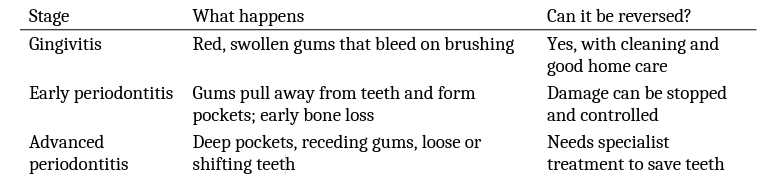
    Stages of gum disease

    Warning signs to watch for

    • Gums that bleed while brushing or eating

    • Red, swollen or tender gums

    • Bad breath or a bad taste that does not go away

    • Gums receding, making teeth look longer

    • Sensitivity near the gum line

    • Loose teeth or new gaps between teeth

    • Pus between the teeth and gums

    Gum disease is often painless in the early stages, so regular check-ups matter.

    How gum disease is treated

    Professional cleaning (scaling). Plaque and tartar are removed from above and just below the gum line. This is usually enough for gingivitis.

    Deep cleaning (scaling and root planing). For periodontitis, the dentist cleans deep inside the gum pockets and smooths the root surfaces so the gums can reattach. It is done under local anaesthesia.

    Laser gum treatment. A dental laser can be used to remove infected gum tissue and reduce bacteria inside the pockets.

    Gum surgery and grafting. In advanced cases, flap surgery, bone grafts or gum grafts help repair the supporting tissues and cover exposed roots.

    What is laser dentistry?

    A dental laser is a focused beam of light energy that can cut or reshape soft tissue with precision. In gum care it is used alongside conventional cleaning, not in place of it.

    Common uses of lasers in dentistry:

    • Treating infected gum pockets

    • Reshaping gums to correct a “gummy” smile

    • Removing excess or overgrown gum tissue

    • Releasing a tongue-tie or lip-tie

    • Treating mouth ulcers and small soft tissue growths

    • Exposing a tooth or implant during treatment

    Benefits of laser treatment

    • Less bleeding during the procedure

    • Often less discomfort and swelling afterwards

    • Stitches are frequently not needed

    • Faster healing of soft tissue

    • Precise, with less effect on nearby healthy tissue

    Not every case is suitable for laser treatment. Your periodontist will advise what suits your gums after an examination.

    Gum health and your general health

    Gum disease is closely linked with diabetes. Poorly controlled blood sugar makes gum infection worse, and gum infection can make blood sugar harder to control. Research has also found associations between gum disease and heart disease and pregnancy complications. Keeping gums healthy is part of looking after your overall health.

    How to keep your gums healthy

    • Brush twice a day with a soft brush and fluoride toothpaste

    • Clean between teeth daily with floss or interdental brushes

    • Get a professional cleaning every six months

    • Quit smoking and tobacco

    • Keep diabetes under control

    • Eat a balanced diet and limit sugary snacks

    Frequently asked questions

    Does scaling weaken teeth or create gaps?

    No. Scaling removes only tartar. Teeth may feel different afterwards because the deposits that filled the spaces are gone.

    Can gum disease be cured?

    Gingivitis can be fully reversed. Periodontitis can be controlled with treatment and regular maintenance.

    Is laser gum treatment painful?

    Most patients find it comfortable. Local anaesthesia is used where needed.

    How often should I get my teeth cleaned?

    Every six months for most people. Those with gum disease may need cleaning every three to four months

    Book a consultation

    Do not ignore bleeding gums. Visit Ishanvi Dental Care & Implant Center at Vivekananda Nagar, Kukatpally, or at Jagathgiri Gutta, Hyderabad. Call +91 70136 60992 or +91 99599 08665 to book an appointment.

  • Missing Teeth? Dental Implants, Bridges and Dentures Explained

    Missing Teeth? Dental Implants, Bridges and Dentures Explained

    A missing tooth is more than a gap in your smile. It changes how you chew and speak, lets neighbouring teeth drift out of place, and slowly thins the jawbone where the tooth used to be. The sooner a lost tooth is replaced, the easier the treatment tends to be.

    At Ishanvi Dental Care & Implant Center in Kukatpally, Hyderabad, tooth replacement is led by implantologists Dr. A. Rithesh Kumar and Dr. A. Jyotsna. This guide compares the three main options, dental implants, fixed bridges and removable dentures, so you can discuss the right one with your dentist.

    Why you should not ignore a missing tooth

    • Nearby teeth tilt into the gap and the bite goes out of balance

    • The opposite tooth can over-grow into the empty space

    • Food gets trapped, raising the risk of decay and gum disease

    • The jawbone under the gap shrinks over time

    • Chewing on one side strains the jaw joint

    • Missing front teeth affect speech and confidence

    Option 1: Dental implants

    A dental implant is a small titanium post placed in the jawbone to act as an artificial tooth root. Over a few months the bone fuses with the implant. A crown is then fixed on top, and it looks and works like a natural tooth.

    Implants can replace a single tooth, several teeth, or support a full set of teeth.

    Advantages

    • Feels and functions closest to a natural tooth

    • Does not need neighbouring teeth to be trimmed

    • Helps preserve the jawbone

    • Fixed in place, with no slipping while eating or talking

    • Can last for many years with good care

    Points to consider

    • Needs a minor surgical procedure

    • Takes a few months from start to finish

    • Higher initial cost than a bridge or denture

    Option 2: Fixed partial dentures (bridges)

    A bridge fills the gap with an artificial tooth that is held by crowns on the teeth on either side. It is cemented in place and is not removed at home.

    Advantages

    • Fixed and comfortable

    • Completed in a few visits, without surgery

    • Lower initial cost than an implant

    Points to consider

    • The supporting teeth must be trimmed to fit crowns

    • Does not prevent bone loss under the gap

    • Needs careful cleaning under the bridge

    Option 3: Removable dentures

    Removable dentures replace several or all teeth and can be taken out for cleaning. Partial dentures clip onto remaining teeth, while complete dentures rest on the gums.

    Advantages

    • Most economical way to replace many teeth

    • No surgery needed

    • Suitable when many teeth are missing

    Points to consider

    • Can feel loose and take time to get used to

    • Less chewing power than fixed options

    • Need relining or replacement as the jaw changes shape

    Implants vs bridges vs dentures at a glance

    Point Dental implant Fixed bridge Removable denture Fixed or removable Fixed Surgery needed Affects nearby teeth Protects jawbone Treatment time Chewing comfort Yes, minor No Yes A few months Closest to natural The dental implant procedure, step by step 1. Fixed No Removable No Yes, they are trimmed Clasps may rest on them No One to two weeks Good No A few weeks Moderate

    The dental implant procedure, step by step

    • Consultation and scan: the dentist examines your mouth and checks bone with X-rays or a 3D scan.
    • Implant placement: the implant is placed in the jawbone under local anaesthesia
    • Healing: the bone bonds with the implant, usually over three to six months. A temporary tooth can be given where needed.
    • Abutment and crown: a connector and a custom-made crown are fixed on the implant.

    Who is a good candidate for implants?

    Most healthy adults with enough jawbone and healthy gums can have implants. Tell your dentist if you have diabetes, smoke, or take long-term medicines, as these affect healing. Gum disease should be treated first, which is where a periodontist’s training matters.

    Caring for your implants

    • Brush twice a day and clean between teeth daily

    • Avoid smoking, which is a leading cause of implant failure

    • Do not bite very hard objects such as ice or bottle caps

    • Visit your dentist every six months for a check-up and cleaning

    Frequently asked questions

    Is dental implant surgery painful?

    It is done under local anaesthesia, so you feel pressure but not pain. Mild soreness for a few days afterwards is managed with medicines.

    How long do dental implants last?

    With good oral hygiene and regular check-ups, implants can last for many years. The crown on top may need replacement after long use.

    Am I too old for implants?

    Age alone is not a barrier. General health and bone quality matter more.

    Can I get an implant years after losing a tooth?

    Often yes. If bone has reduced, a bone graft may be advised first.

    Book a consultation

    Find out which tooth replacement suits you. Visit Ishanvi Dental Care & Implant Center at Vivekananda Nagar, Kukatpally, or at Jagathgiri Gutta, Hyderabad. Call +91 70136 60992 or +91 99599 08665 to book an appointment.