Blog

  • Back Pain That Won’t Go Away: 7 Signs You Should See a Pain Specialist

    Back Pain That Won’t Go Away: 7 Signs You Should See a Pain Specialist

    Almost everyone has back pain at some point. Most episodes settle within a few weeks with simple care. The problem starts when people keep managing with painkillers, balms and belts for months while the real cause goes untreated. Here is how to tell when it is time to see a specialist.

    7 signs you should not ignore

    1. Pain lasting more than four to six weeks despite rest, medicines or home care.
    2. Pain that travels down a leg, especially below the knee.
    3. Numbness, tingling or weakness in a leg or foot.
    4. Pain that wakes you at night or is worse when you lie down.
    5. Morning stiffness lasting more than 30 minutes, particularly under the age of 40.
    6. Pain after a fall or injury, or in anyone with osteoporosis.
    7. Back pain with fever, unexplained weight loss, or loss of bladder or bowel control. This last group needs urgent medical care.

    Why the exact cause matters

    “Back pain” is a symptom, not a diagnosis. It may come from a disc, the small facet joints, the sacroiliac joint, muscles, a pinched nerve or, in older adults, a weak vertebra. Each has a different treatment. A painkiller covers all of them for a few hours and fixes none.

    What is a pain specialist?

    A pain specialist is a doctor trained to diagnose the source of pain and treat it with medication, rehabilitation and precise, image-guided procedures. The goal is to relieve pain and restore movement while avoiding surgery wherever it is safe to do so.

    What happens at your first visit

    • A detailed conversation about your pain, work, sleep and past treatment
    • A physical and neurological examination
    • Review of earlier X-rays or MRI scans, with new tests only if needed
    • A clear explanation of the likely cause and a step-by-step treatment plan

    Carry your old reports and a list of current medicines.

    Non-surgical treatments for back pain

    • Medication tailored to the type of pain
    • A physiotherapy and core-strengthening programme
    • Trigger point injections for muscle pain
    • Facet joint and sacroiliac joint injections
    • Epidural injections for nerve-related pain
    • Radiofrequency ablation for longer-lasting relief from joint pain

    Most of these are day-care procedures done under local anaesthesia, and patients usually return home the same day.

    Everyday habits for a healthier back

    • Stay active. Walking, swimming and yoga under guidance all help.
    • Break up long sitting with short movement breaks.
    • Use a firm, supportive mattress and chair.
    • Keep your weight in a healthy range.
    • Do not self-medicate with painkillers for weeks. They can harm the stomach and kidneys.

  • Neck Pain from Desk Work: A Guide for Hyderabad’s IT Professionals

    Neck Pain from Desk Work: A Guide for Hyderabad’s IT Professionals

    If you work in the Financial District, Gachibowli or from a home desk in Kokapet, your neck probably spends eight to ten hours a day tilted toward a screen. Add the commute and phone scrolling, and it is no surprise that neck pain is one of the most common complaints among working professionals in Hyderabad.

    Why screens strain your neck

    Your head weighs around five kilograms. When it stays balanced over your shoulders, the neck handles that load easily. As the head tilts forward, the load on the neck muscles and discs rises sharply. Hold that posture for hours every day and the muscles tire, joints stiffen and discs come under strain. This pattern is often called “tech neck”.

    Common causes of neck pain

    • Muscle strain from poor posture and long static sitting
    • Cervical spondylosis, the age-related wear of neck discs and joints
    • Cervical disc bulge pressing on a nerve
    • Facet joint pain from the small joints at the back of the neck
    • Stress, poor sleep and an unsuitable pillow, which make all of the above worse

    Symptoms you should not ignore

    • Neck stiffness and pain that spreads to the shoulders or upper back
    • Headaches that start at the base of the skull
    • Tingling, numbness or pain running down an arm
    • Weak grip or dropping objects
    • Dizziness or loss of balance along with neck pain

    Five fixes you can start today

    1. Raise your screen. The top of the monitor should sit at eye level. Use a laptop stand with an external keyboard.
    2. Follow the 30-minute rule. Stand, stretch or walk for a minute or two every half hour.
    3. Bring the phone up to your eyes. Do not drop your head to the phone.
    4. Do three stretches twice a day. Chin tucks, shoulder blade squeezes and gentle side neck stretches, ten repetitions each.
    5. Check your pillow. It should keep your neck level with your spine, not push it up or let it sag.

    When to see a pain specialist

    Book a consultation if the pain has lasted more than two weeks, keeps coming back, travels into your arm, or comes with numbness or weakness. Pain after a fall or accident, or with fever, needs prompt medical attention.

    How neck pain is treated without surgery

    Treatment starts with a clear diagnosis through examination and, where needed, an X-ray or MRI. Options then include medication, a structured physiotherapy plan, trigger point injections for tight muscle knots, and image-guided procedures such as cervical epidural injections, facet joint blocks or radiofrequency treatment for longer-lasting relief. Your doctor chooses based on the exact source of pain.

  • Slip Disc: Do You Really Need Surgery?

    Slip Disc: Do You Really Need Surgery?

    Hearing the words “slip disc” after an MRI can be frightening. Many patients assume an operation is the next step. In reality, the large majority of slip disc cases improve with non-surgical care, and many disc bulges shrink on their own over time.

    What actually happens in a slip disc?

    Between each pair of spinal bones sits a disc, a cushion with a soft gel centre and a tough outer ring. With age, strain or sudden load, the outer ring can weaken and the gel pushes outward. When that bulge touches a nearby nerve, you feel pain. The disc does not actually slip out of place.

    It most often affects the lower back at the L4-L5 and L5-S1 levels, and the neck at C5-C6.

    Symptoms

    • Lower back or neck pain that spreads into a leg or arm
    • Tingling, numbness or a burning feeling along the limb
    • Pain that increases on bending, lifting, coughing or sitting for long
    • Weakness when gripping, lifting the foot or climbing stairs

    Who is at risk?

    People between 30 and 50 are affected most. Long sitting hours, heavy or incorrect lifting, smoking, excess weight and a weak core all add to the load on your discs.

    An MRI report is not a verdict

    Disc bulges are common even in people with no pain at all. That is why treatment is based on your symptoms and examination, not the scan alone. A report that sounds alarming does not automatically mean surgery.

    Non-surgical treatments that work

    1. Relative rest and medication. A few days of reduced activity and anti-inflammatory or nerve pain medicines during the acute phase.
    2. Guided physiotherapy. Exercises that reduce pressure on the disc and build the muscles that support the spine.
    3. Epidural steroid injection. Medicine is placed around the irritated nerve under X-ray or ultrasound guidance to reduce inflammation.
    4. Selective nerve root block. Used to confirm which nerve is causing pain and to relieve it.
    5. Minimally invasive disc procedures. Considered for selected patients whose pain continues despite the steps above.

    When surgery is the right choice

    Surgery is recommended when there is loss of bladder or bowel control, numbness in the groin area, weakness that keeps getting worse, or severe pain that has not improved after six to twelve weeks of proper treatment. An honest specialist will tell you clearly if you fall in this group.

    Protecting your discs

    • Take a movement break every 30 to 40 minutes
    • Lift with your legs and keep the load close to your body
    • Build core and back strength with regular exercise
    • Maintain a healthy weight and avoid smoking

  • Sciatica Pain: Causes, Symptoms and Non-Surgical Treatment in Hyderabad

    Sciatica Pain: Causes, Symptoms and Non-Surgical Treatment in Hyderabad

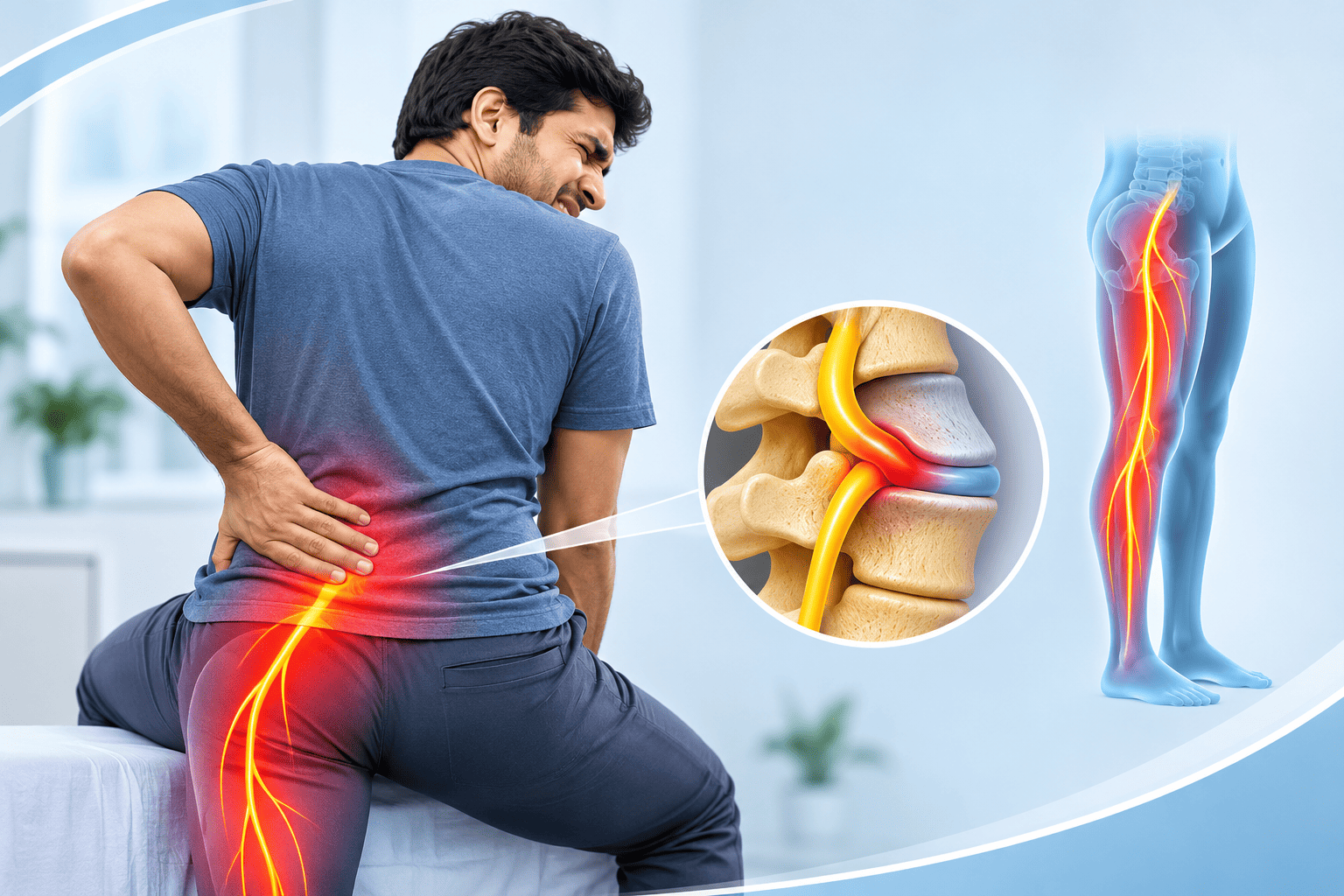
    If a sharp, electric pain runs from your lower back through your buttock and down one leg, you are probably dealing with sciatica. It can make sitting through a meeting, driving on the ORR or even turning in bed feel impossible. The good news is that most people recover without surgery.

    What is sciatica?

    Sciatica is not a disease. It is a set of symptoms caused by irritation or pressure on the sciatic nerve, the longest nerve in the body. This nerve starts in the lower spine and travels down each leg, which is why the pain follows that same path.

    Common causes

    • A slipped (herniated) disc pressing on a nerve root, the most frequent cause
    • Spinal stenosis, a narrowing of the spinal canal that is more common after 50
    • Piriformis syndrome, where a tight buttock muscle irritates the nerve
    • Spondylolisthesis, where one vertebra slips forward over another
    • Long hours of sitting, weak core muscles and excess weight, which raise the risk

    Symptoms to watch for

    • Pain that travels from the lower back or buttock down the back of one leg
    • Burning, tingling or a pins-and-needles feeling in the leg or foot
    • Numbness or weakness in the leg
    • Pain that gets worse with sitting, coughing or sneezing

    How sciatica is diagnosed

    A pain specialist begins with your history and a physical examination, including tests of strength, reflexes and a straight-leg raise. An MRI is advised when the pain is severe, lasts beyond a few weeks or comes with weakness. The aim is to find the exact nerve involved, because treatment works best when it is targeted.

    Non-surgical treatment options

    1. Medication and activity advice. Short courses of pain and nerve medicines, with guidance to stay gently active. Long bed rest slows recovery.
    2. Physiotherapy. Stretching, nerve-gliding and core-strengthening exercises designed for your condition.
    3. Image-guided injections. An epidural steroid injection or selective nerve root block delivers medicine precisely around the inflamed nerve to calm pain and swelling.
    4. Advanced procedures. For pain that persists, options such as radiofrequency treatment may be considered after a full evaluation.

    These are day-care procedures. Most patients walk out the same day.

    When is it an emergency?

    See a doctor immediately if you have loss of bladder or bowel control, numbness around the groin or inner thighs, or sudden weakness in one or both legs. These signs need urgent attention.

    Simple habits that help

    • Stand up and move every 30 to 40 minutes
    • Keep your screen at eye level and your feet flat on the floor
    • Walk daily and strengthen your core
    • Bend at the knees, not the waist, when lifting